 Email us -
 Messaging
 OnDemand
 Social Networking
 E-commerce
 Job Search
 Education
 Food
Food
 Conference
 Travel
 Linphone
 Geofence
 Medical
 Taxi
Taxi
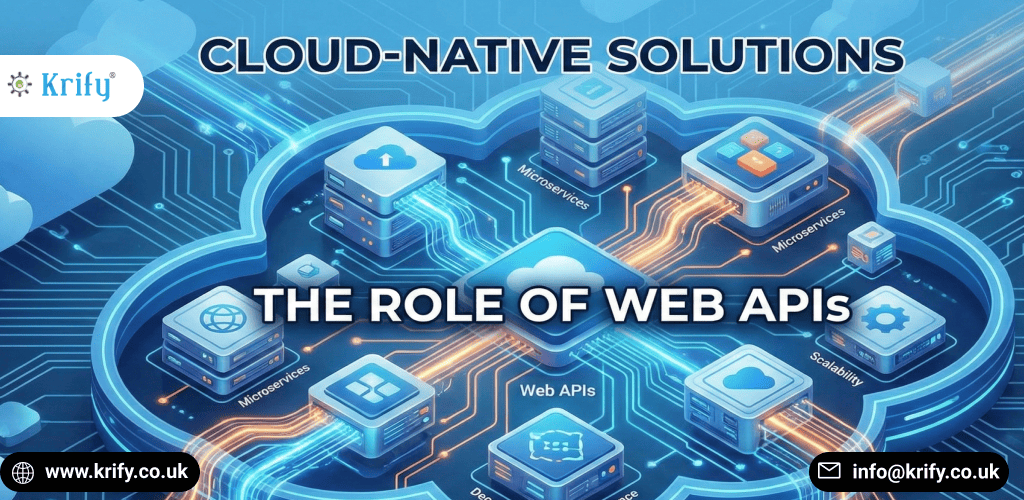
When you start digging into how modern apps are built, you eventually hit a point where everything traces back to APIs. It almost feels like no matter what feature you’re looking at—authentication, payments, notifications, analytics—some API is quietly doing the heavy lifting. And that’s really why The Role of Web APIs in Driving Cloud-Native Solutions has become such a big topic.
Moreover, the more companies shift toward cloud-native tech, the more obvious it becomes that APIs aren’t just “helpers.” They’re the backbone. Without them, the whole structure falls apart.
It took me a while to appreciate this myself. You look at a cloud-native diagram and it seems simple—boxes, arrows, maybe a Kubernetes cluster floating in the middle. But once you build something real, you realize the arrows (the APIs) matter just as much as the boxes.
Why APIs Became the Heart of Cloud-Native Systems
Cloud-native systems don’t work like old monolithic apps. They’re more like a group of small, independent services that all need to coordinate but also stand on their own. However, if those services can’t communicate cleanly, the system becomes messy fast.
In addition, integrations have become normal—CRMs, payment systems, AI engines, analytics dashboards, you name it. APIs make that world possible.
1. APIs Help Microservices Behave Like One App
If microservices are the organs, APIs are the nerves connecting everything. They make dozens of separate services feel like one product.
Why it actually matters:
When one piece updates, everything doesn’t break. Moreover, teams can ship faster without waiting on each other every step of the way.
2. Serverless Apps Depend on APIs to Function
Serverless functions wake up, do their job, and go back to sleep. APIs are usually the reason they wake up in the first place.
Practical perks:
- Lower infrastructure costs
- Smooth scaling
- Easier development
And in addition, teams don’t babysit servers anymore.
3. APIs Make Scaling Much Less Painful
Cloud-native apps should handle sudden traffic without panicking. APIs help distribute the workload gracefully.
What this means for real apps:
Your system doesn’t melt during peak hours. Furthermore, you can scale just one part of the system instead of the whole thing.
4. APIs Simplify Integrations with Other Platforms
Most businesses rely on outside tools—Stripe, Google Maps, PayPal, Salesforce, you name it.
APIs make those integrations easy instead of stressful.
Plus:
You don’t have to rebuild features that already exist elsewhere.
5. APIs Strengthen DevOps and Automated Pipelines
Cloud-native isn’t just about tech—it’s also about how teams build and ship software. APIs help CI/CD tools automate everything smoothly.
Why DevOps teams love API-driven setups:
- Faster builds
- Repeatable deployments
- Less manual “fix this later” work
Moreover, automation reduces human errors.
6. APIs Keep Data Moving Safely Across Distributed Systems
In cloud-native apps, data hops between many components—storage systems, compute layers, cache servers, and frontends.
APIs keep all that movement predictable, clean, and secure.
In addition:
They help enforce permissions and validation, which keeps sensitive data from leaking.
7. APIs Improve the End-User Experience
When an app feels smooth—fast loading, instant responses, real-time updates—it’s usually because the APIs are doing a good job behind the scenes.
In other words:
A great API makes an app feel “easy,” even if the logic behind it is complex. Furthermore, fewer errors reach the user.
8. APIs Make Hybrid and Multi-Cloud Architectures Practical
Many companies aren’t loyal to just one cloud provider anymore. They mix and match. APIs are what make that level of freedom possible.
Why it’s a big deal:
- Better disaster recovery
- No vendor lock-in
- More room to innovate
Additionally, APIs help connect old on-premise systems to new cloud-native layers.
A Realistic Example of APIs in Cloud-Native Workflows
Imagine an e-commerce app split into microservices:
payments, search, inventory, user profiles, notifications.
Without APIs: total chaos.
With APIs: each service knows exactly how to talk to the others.
You can upgrade the search engine… without touching payments.
You can replace notifications… without rewriting the entire system.
This freedom is exactly what cloud-native development is supposed to feel like.
Why Companies Are Choosing API-First Design
API-first design isn’t just a trend. It’s a smarter approach for complex apps.
Because:
- APIs shape the system early
- Teams design features that communicate correctly
- Integrations become easier later
In addition, documentation becomes cleaner, which helps both developers and engineers who join the team later.
Conclusion
Cloud-native systems don’t exist without Web APIs. They’re the reason microservices work, the reason integrations exist, and the reason modern apps feel smooth. As companies modernize their stacks, APIs keep everything connected, scalable, and ready for future growth.If you’re planning to build or modernize a cloud-native application and want help designing strong, reliable APIs, feel free to Contact us—we’re always happy to guide you.