 Email us -
 Messaging
 OnDemand
 Social Networking
 E-commerce
 Job Search
 Dating
 Fleet Management
 Parking
 News
News
 Education
 Food
Food
 Conference
 Travel
 Casting
 LMS
LMS
 Feedback
 Dental Clinic
 Meeting
 Linphone
 Geofence
 Medical
 Taxi
Taxi
 Matrimony
 Attendance Management
 Pharmacy
 Multi Purpose CRM


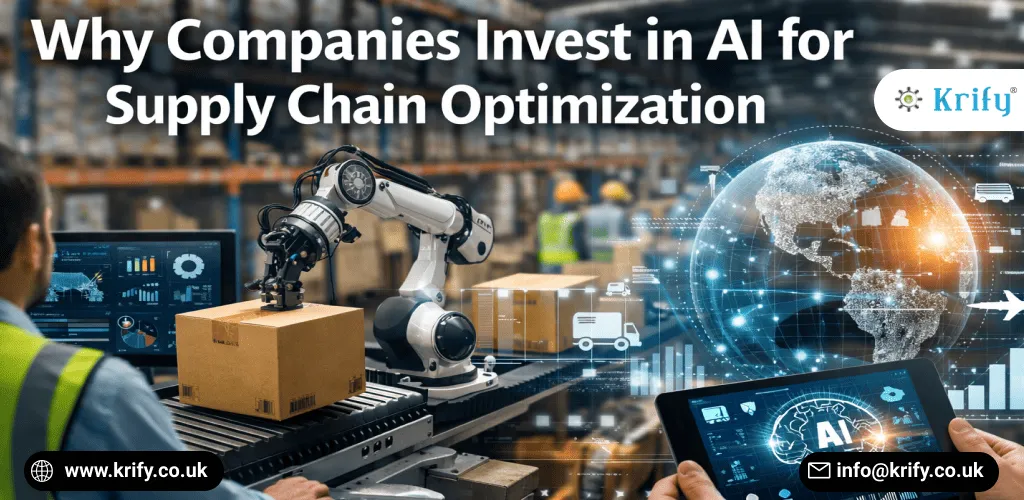
Supply chains have never been simple, but in recent years, they’ve become even more unpredictable. Demand shifts quickly, disruptions appear without warning, and customer expectations continue to rise. That’s exactly why AI Supply Chain optimization has become a serious investment priority for many companies. Businesses are no longer experimenting with AI out of curiosity—they’re adopting it out of necessity. At Krify, we’ve seen organizations turn to AI not for flashy innovation, but to bring clarity and stability to complex supply networks. Moreover, AI helps teams move from reacting to problems to anticipating them.
Traditional supply chain tools still have value. However, they struggle to keep up with today’s speed and volume of data. Therefore, companies are looking for smarter systems that can learn, adapt, and improve decisions over time.
AI Supply Chain Optimization in Real Operations
Supply chains generate massive amounts of data—orders, shipments, inventory levels, supplier performance, and more. On its own, that data doesn’t help much. AI changes that by turning information into insight.
For example, AI models analyze historical trends alongside real-time signals. In addition, they identify patterns humans often miss. As a result, teams gain visibility into what’s likely to happen next, not just what already happened.
Moreover, AI doesn’t replace planners. Instead, it supports them with better recommendations, faster analysis, and clearer risk signals.
Improved Demand Forecasting and Planning
Forecasting has always been a challenge. Markets shift, promotions impact demand, and external factors disrupt patterns. AI improves forecasting by learning from multiple data sources at once.
Therefore, forecasts become more accurate over time. In addition, planners can adjust strategies earlier instead of reacting late. Consequently, companies reduce stockouts, excess inventory, and last-minute firefighting.
Better Inventory Management
Holding too much inventory ties up capital. Holding too little leads to missed sales. AI helps companies find the balance.
By continuously analyzing demand, lead times, and supplier reliability, AI suggests optimal inventory levels. Moreover, it adapts as conditions change. As a result, inventory decisions become data-driven rather than assumption-based.
Faster Response to Disruptions
Disruptions are unavoidable. What matters is how quickly companies respond.
AI systems monitor supply chain signals in real time. For instance, they detect delays, demand spikes, or supplier risks early. Therefore, teams can adjust routes, reallocate inventory, or activate backup suppliers sooner. In addition, faster response reduces downstream impact.
Smarter Supplier and Logistics Decisions
Supplier performance varies. Delivery times fluctuate. Costs change. AI helps companies evaluate suppliers based on real data rather than static scorecards.
Moreover, AI models compare multiple logistics scenarios at once. Consequently, businesses choose routes and partners that balance cost, speed, and reliability. Over time, this leads to more resilient supply networks.
Cost Reduction Without Compromising Service
One common misconception is that AI is only about automation. In reality, it’s about smarter decisions.
AI highlights inefficiencies that often go unnoticed—ineffective routes, excess safety stock, or poor forecast assumptions. Therefore, companies reduce costs while maintaining service levels. In addition, savings compound as models improve.
Scalability as Operations Grow
As companies expand, supply chains become harder to manage manually. AI scales naturally with growth.
Whether it’s handling more SKUs, new regions, or complex product mixes, AI systems adjust faster than traditional tools. As a result, companies grow without losing control.
At Krify, we’ve noticed that businesses adopting AI early adapt more smoothly as operations become more complex.
Why AI Is Becoming a Strategic Investment
AI isn’t just a technical upgrade—it’s a strategic shift. Companies that invest in AI gain better visibility, stronger resilience, and faster decision-making.
Moreover, AI helps leadership move from reactive problem-solving to proactive planning. Therefore, supply chains become competitive advantages rather than constant risks.
Conclusion
Supply chain complexity isn’t going away. That’s why companies continue investing in AI Supply Chain optimization to improve forecasting, manage inventory, respond to disruptions, and scale with confidence. If you’re exploring how AI can strengthen your supply chain strategy, Contact us to discuss how intelligent solutions can support your business goals.
Get In Touch
Have questions? Fill out the form below and our team will contact you shortly.