 Email us -
 Messaging
 OnDemand
 Social Networking
 E-commerce
 Job Search
 Dating
 Fleet Management
 Parking
 News
News
 Education
 Food
Food
 Conference
 Travel
 Casting
 LMS
LMS
 Feedback
 Dental Clinic
 Meeting
 Linphone
 Geofence
 Medical
 Taxi
Taxi
 Matrimony
 Attendance Management
 Pharmacy
 Multi Purpose CRM


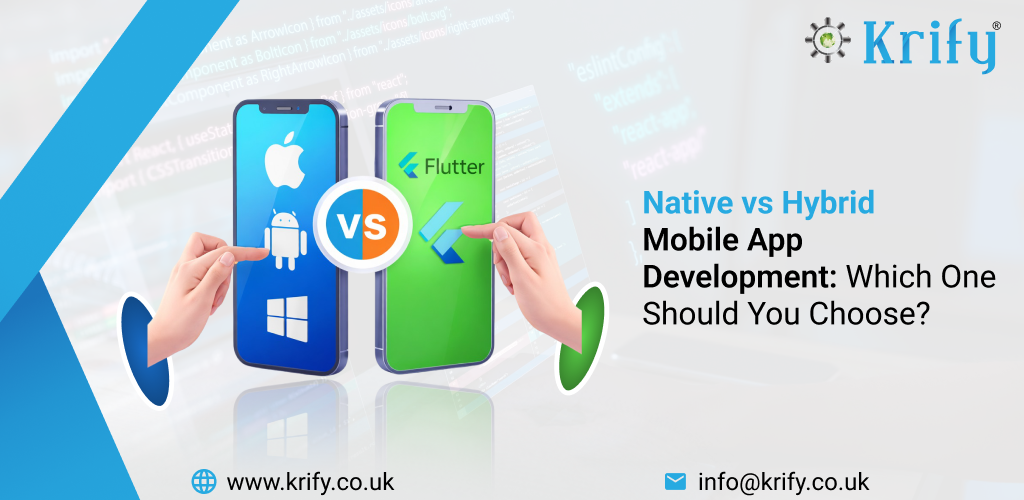
In today’s world, organizations need to consider the best mobile app development strategy for keeping up with their competitors. Nevertheless, deciding between using the native or hybrid approach is not an easy task. Thus, knowledge of native vs hybrid mobile apps is crucial for making sound choices. This is where Krify comes into play.
Native vs Hybrid Mobile Apps
The comparison between native and hybrid mobile apps means the comparison of two main ways of creating mobile applications. The first way is creating applications specially for one particular platform, such as Android or iOS. The other way of creating applications is creating one common application for all available platforms.
Basic differences include:
- Native apps use platform-specific languages
- Hybrid apps use shared codebases
- Native apps offer better performance
- Hybrid apps reduce development time
- Native apps provide deeper device integration
Why Businesses Compare Native vs Hybrid Mobile Apps
It is essential for firms to strike a balance between performance, cost, and scalability. As such, a comparative analysis of native vs hybrid mobile apps is crucial in determining the most suitable solution.
Key decision factors:
- Budget constraints
- Time to market requirements
- Target platforms (Android, iOS, or both)
- App complexity
- User experience expectations
Key Differences in Native vs Hybrid Apps
1. Performance
Native apps work faster while offering seamless user experience. The performance of hybrid apps is dependent on complexity.
2. Development Cost
It costs more to develop native apps because each application must be built separately. Developing hybrid apps is cheaper.
3. User Experience
User interface design is better in the case of native apps. Hybrid apps offer uniform user interface design across all platforms.
4. Development Time
Native apps take time to develop because developers create code separately for each application. Hybrid apps can be developed faster.
5. Maintenance
Updates on native apps must be done separately for each app. Maintaining hybrid apps is easier with one codebase.
6. Scalability
Native apps are highly scalable when it comes to performance-based applications. Hybrid apps are efficient for scalability purposes.
Advantages of Native Apps
Native apps are ideal for high-performance applications.
Key benefits:
- Faster speed and responsiveness
- Better user experience
- Full device feature access
- Strong security capabilities
- Offline functionality support
Advantages of Hybrid Apps
Hybrid apps are suitable for cost-effective development.
Key benefits:
- Single codebase for multiple platforms
- Faster development cycle
- Lower development cost
- Easier updates and maintenance
- Wider audience reach
Krify’s Expertise in Mobile App Development
Krify helps businesses choose between native and hybrid mobile applications based on their needs. Krify creates scalable mobile apps tailored to meet the needs of your business.
Our services include:
- Native app development
- Hybrid app development
- UI/UX design
- App testing and deployment
- Ongoing maintenance and support
This strengthens decision making for native vs hybrid apps.
Which One Should You Choose?
Choosing between native vs hybrid apps depends on business priorities. Therefore, companies must evaluate performance, budget, and timeline.
Choose native apps if:
- You need high performance
- You require complex features
- You prioritize user experience
Choose hybrid apps if:
- You want faster development
- You have a limited budget
- You need cross platform reach
Conclusion
Knowing the differences between native vs hybrid mobile applications makes it easier for companies to make decisions that will benefit them greatly. Each one is associated with its own strengths, and companies can choose from both based on their needs and wants. At Krify, we guide our clients in developing the best mobile app, contact us today.
Get In Touch
Have questions? Fill out the form below and our team will contact you shortly.